We’re excited to announce a new data citation API endpoint and are seeking your feedback. The new service makes existing data citation relationships in our metadata available, thereby surfacing this part of the research nexus. At the same time, we’ve decided that it’s time to move on from Event Data.
Metadata is communication; it can tell a story about research and paint a picture for others to respond to and learn from, across the world and throughout the forthcoming generations. Metadata can feel technical with words like ‘infrastructure’ and ‘schema’, and sometimes, like tech in general, it comes with hyperbole. But metadata really is part art (storytelling and pictures) and part science (structured models and standards) with both aspects being equally important, and requiring people as well as systems. That necessary combination of human and machine involvement also makes metadata challenging.
Once a year we release all metadata records for content registered with Crossref in a public data file. This year’s version, containing nearly 180 million records, is now available. It includes metadata associated with all Crossref-registered DOIs in JSON-lines format.
Crossref Ambassadors act as local points of contact, meeting editors, librarians, researchers, and institutions to help them navigate Crossref services and understand how strong metadata supports visibility, integrity, and trust in research. They explain how to participate in our rich network of connections between works, people, and institutions, in ways that make sense in their own contexts. And last year, being our 25th anniversary, Ambassadors also massively contributed to our celebrations!
TL;DR: We no longer charge fees for members to participate in Crossmark, and we encourage all our members to register metadata about corrections and retractions - even if you can’t yet add the Crossmark button and pop-up box to your landing pages or PDFs.
–
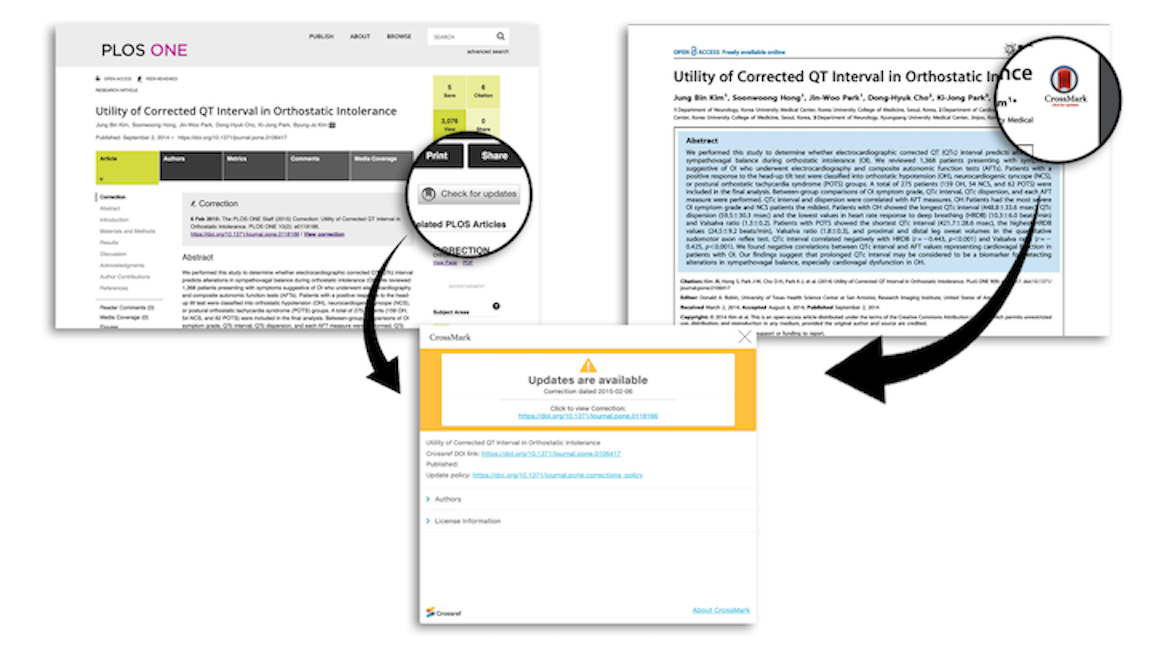
Research doesn’t stand still; even after publication, articles can be updated with supplementary data or corrections. When research outputs are is changed in this way the publisher should report and link it, so that those accessing and citing the content know if it’s been updated, corrected or even retracted. This also emphasizes the member’s commitment to the ongoing stewardship of research outputs.
Many people find and store articles to read later, either as PDFs on their laptop or on one of any number of reference management systems - when they come back to read and cite these articles, possibly many months later, they want to know if the version they have is current or not.
Removing Crossmark fees
To encourage even wider adoption of Crossmark, and to promote best practice around better reporting of corrections and retractions, we will no longer be charging additional fees for our Crossmark service. This change applies to all Crossmark metadata registered from 1 January 2020. All members are now encouraged to add Crossmark metadata and add the Crossmark button and pop-up box to their publications - and you can do so as part of your regular content registration.
Richer metadata gives important context
We know that there are many more corrections and retractions that are not yet being registered, and to address this, we are now asking all of our members to start registering metadata for significant updates to your publications, even if you don’t implement the Crossmark button and pop-up box on your content. Remember, anyone can access the Crossmark metadata through our public REST API, and start using it straight away - even if you’re not ready to implement the Crossmark button.
Check out how to get started; if you only want to deposit metadata, follow steps one through four. If you also want to add the Crossmark button and pop-up box to your web pages/PDFs so that readers can easily see when content has changed, then also follow the rest of the steps.
Crossmark
We launched Crossmark in 2012 to raise awareness of these critical changes, by asking Crossref members to:
help readers find out about the changes by placing a Crossmark button and pop-up box (which is consistent across all members making it recognizable to readers) on your landing pages and in PDFs
Members can also use Crossmark to register additional metadata about content, giving further context and background for the reader. These metadata appear in the “More Information” section of the Crossmark box. 7 million DOIs have some additional metadata, the most common being copyright statements, publication history, and peer review methods.
Anyone can access the Crossmark metadata through our public REST API, providing a myriad of opportunities for integration with other systems, and analysis of changes to the scholarly record.
Who has implemented Crossmark?
440 Crossref members have implemented Crossmark to date. 11.4 million DOIs have some Crossmark metadata.
Total DOIs
DOIs with Crossmark metadata
%
Journal articles
80,862,460
10,155,340
12.56%
Book chapters
14,040,646
792,953
5.65%
Conference Papers
6,175,733
457,237
7.40%
Datasets
1,862,852
19,206
1.03%
Books
753,298
239
0.03%
Monographs
469,333
23
0.00%
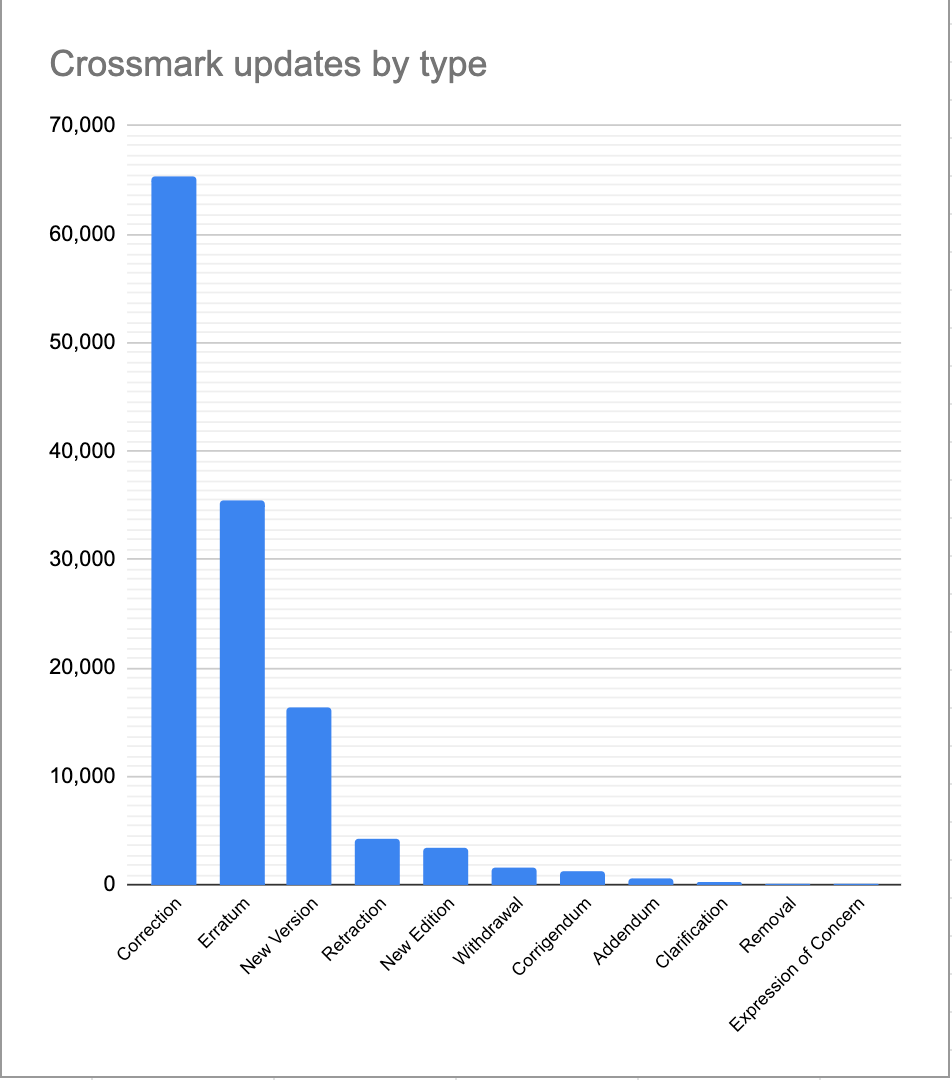
Of those, about 130,000 contain an update:
You can see which members or journals have implemented Crossmark by viewing the relevant Crossref Participation Report.