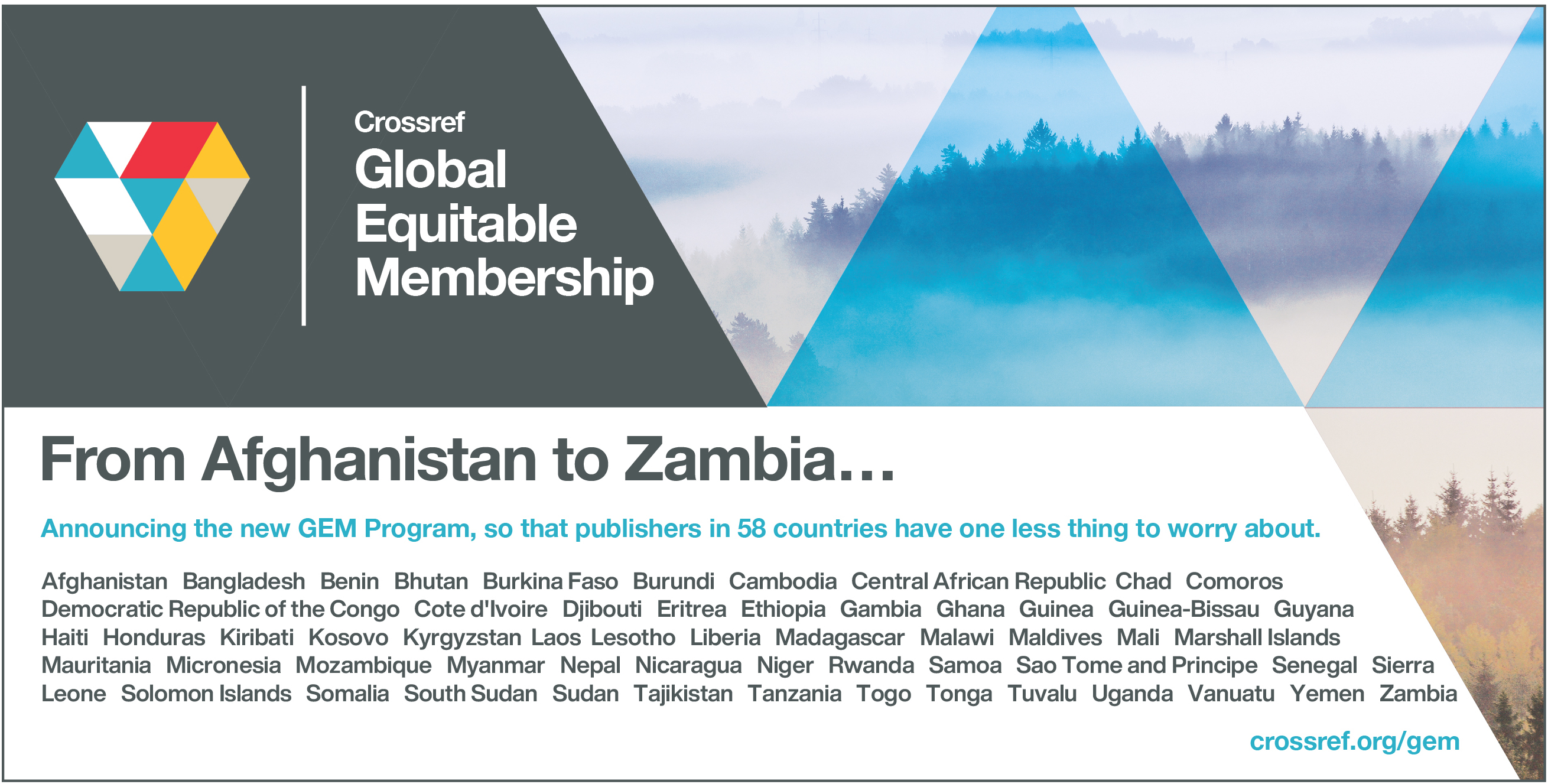
As Crossref membership continues to grow, finding ways to help organisations participate is an important part of our mission. Although Crossref membership is open to all organisations that produce scholarly and professional materials, cost and technical challenges can be barriers to joining for many.
We are pleased to announce that—effective 1st January 2026—we have made two changes to grant record registration fees that aim to accelerate adoption of Crossref’s Grant Linking System (GLS) and provide a two-year window of opportunity to increase the number and availability of open persistent grant identifiers and boost the matching of relationships with research objects.
We are very pleased to kick off the New Year with another important schema update and the news that a Grant DOI field is now supported for all record types. This means that Crossref members can explicitly include the Crossref Grant IDs as part of their DOI metadata records for publications and any other output type, accurately linking research outputs to the funding that made it possible, all through metadata. We hope that our members will leverage this to respond to recent calls for stronger funding transparency and best practices for reporting funding sources in research outputs.Â
As we finish celebrating our 25th anniversary, we can look back on a truly transformational year, defined by the successful delivery of several long-planned, foundational projects—as well as updates to our teams, services, and fees—that position Crossref for success over the next quarter century as essential open scholarly infrastructure. In our update at the end of 2024, we highlighted that we had restructured our leadership team and paused some projects. The changes made in 2024 positioned us for a year of getting things done in 2025. We launched cross-functional programs, modernised our systems, strengthened connections with our growing global community, and streamlined a bunch of technical and business operations while continuing to grow our staff, members, content, relationships, and community connections.
We are pleased to announce that—effective 1st January 2026—we have made two changes to grant record registration fees that aim to accelerate adoption of Crossref’s Grant Linking System (GLS) and provide a two-year window of opportunity to increase the number and availability of open persistent grant identifiers and boost the matching of relationships with research objects.
The Crossref Board recently approved three recommendations for changes to our fees: introduction of a new lowest membership fee tier, removal of volume discounts for record registration, and normalisation of registration fees for peer reviews. The changes will be applied from January 2026.
This is the first outcome of the Resourcing Crossref for Future Sustainability (RCFS) program, launched in 2023, as a comprehensive effort to review all aspects of Crossref revenue and how we’re adapting to growth and the diversification of our membership. The program aims to make fees more equitable, simplify our complex fee schedule, and rebalance revenue sources.
We’re in year two of the Resourcing Crossref for Future Sustainability (RCFS) research. This report provides an update on progress to date, specifically on research we’ve conducted to better understand the impact of our fees and possible changes.
Crossref is in a good financial position with our current fees, which haven’t increased in 20 years. This project is seeking to future-proof our fees by:
Making fees more equitable
Simplifying our complex fee schedule
Rebalancing revenue sources
In order to review all aspects of our fees, we’ve planned five projects to look into specific aspects of our current fees that may need to change to achieve the goals above. This is an update on the research and discussions that have been underway with our Membership & Fees Committee and our Board, and what we’ve learned so far in each of these areas.
Crossref is undertaking a large program, dubbed 'RCFS' (Resourcing Crossref for Future Sustainability) that will initially tackle five specific issues with our fees. We haven’t increased any of our fees in nearly two decades, and while we’re still okay financially and do not have a revenue growth goal, we do have inclusion and simplification goals. This report from Research Consulting helped to narrow down the five priority projects for 2024-2025 around these three core goals:
When Crossref began over 20 years ago, our members were primarily from the United States and Western Europe, but for several years our membership has been more global and diverse, growing to almost 18,000 organisations around the world, representing 148 countries.
As we continue to grow, finding ways to help organisations participate in Crossref is an important part of our mission and approach. Our goal of creating the Research Nexus—a rich and reusable open network of relationships connecting research organisations, people, things, and actions; a scholarly record that the global community can build on forever, for the benefit of society—can only be achieved by ensuring that participation in Crossref is accessible to all. Building a network for the global community must include input from all of the global community.Â