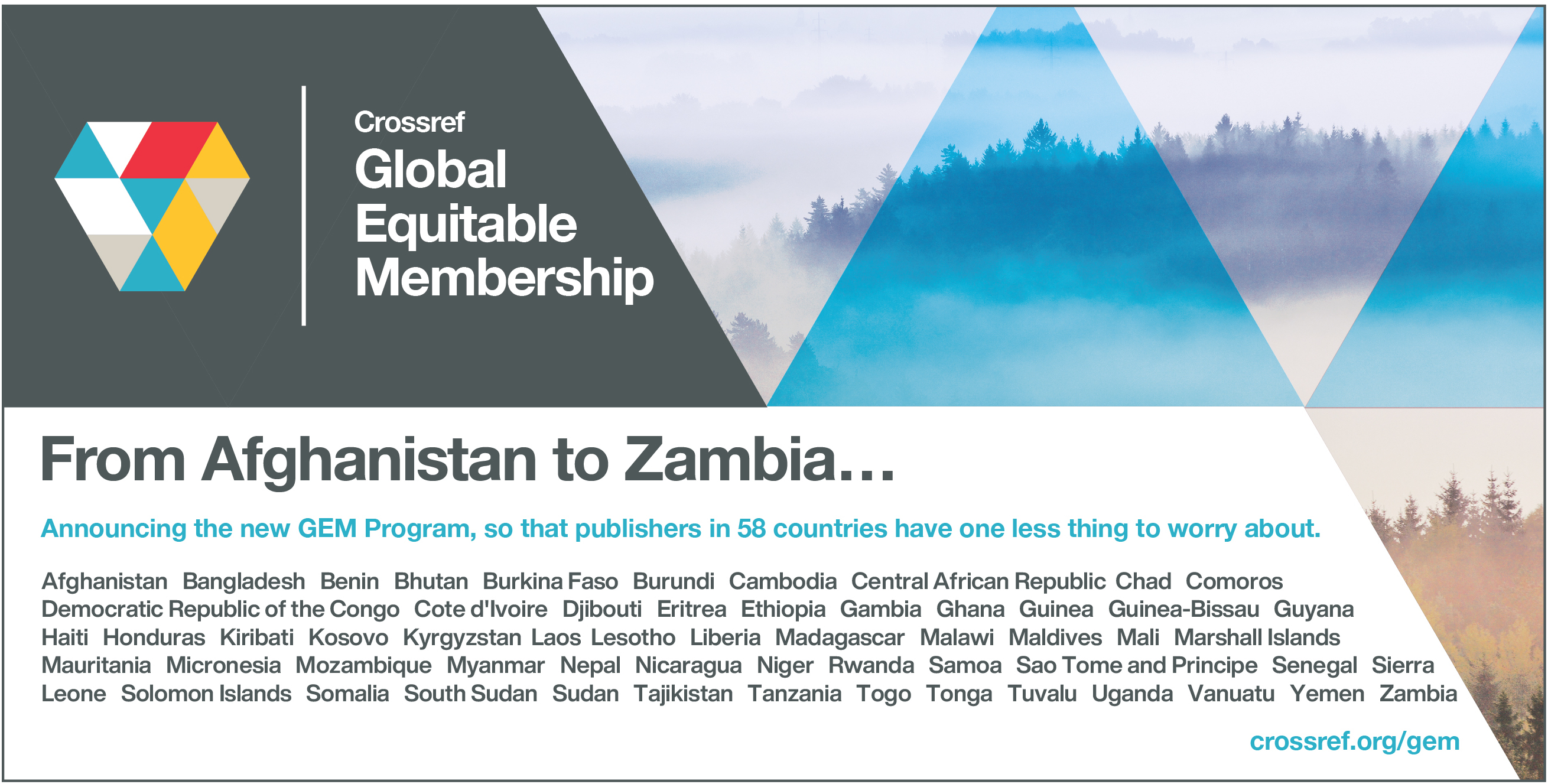
As Crossref membership continues to grow, finding ways to help organisations participate is an important part of our mission. Although Crossref membership is open to all organisations that produce scholarly and professional materials, cost and technical challenges can be barriers to joining for many.
We are pleased to announce that—effective 1st January 2026—we have made two changes to grant record registration fees that aim to accelerate adoption of Crossref’s Grant Linking System (GLS) and provide a two-year window of opportunity to increase the number and availability of open persistent grant identifiers and boost the matching of relationships with research objects.
We are very pleased to kick off the New Year with another important schema update and the news that a Grant DOI field is now supported for all record types. This means that Crossref members can explicitly include the Crossref Grant IDs as part of their DOI metadata records for publications and any other output type, accurately linking research outputs to the funding that made it possible, all through metadata. We hope that our members will leverage this to respond to recent calls for stronger funding transparency and best practices for reporting funding sources in research outputs.Â
As we finish celebrating our 25th anniversary, we can look back on a truly transformational year, defined by the successful delivery of several long-planned, foundational projects—as well as updates to our teams, services, and fees—that position Crossref for success over the next quarter century as essential open scholarly infrastructure. In our update at the end of 2024, we highlighted that we had restructured our leadership team and paused some projects. The changes made in 2024 positioned us for a year of getting things done in 2025. We launched cross-functional programs, modernised our systems, strengthened connections with our growing global community, and streamlined a bunch of technical and business operations while continuing to grow our staff, members, content, relationships, and community connections.
Wednesday 22nd October 2025—Crossref, the open scholarly infrastructure nonprofit, today releases an enhanced dashboard showing metadata coverage and individual organisations’ contributions to documenting the process and outputs of scientific research in the open. The tool helps research-performing, funding, and publishing organisations identify gaps in open research information, and provides supporting evidence for movements like the Barcelona Declaration for Open Research Information, which encourages more substantial commitment to stewarding and enriching the scholarly record through open metadata.
Crossref and the Public Knowledge Project (PKP) have been working closely together for many years, sharing resources and supporting our overlapping communities of organisations involved in communicating research. Now we’re delighted to share that we have agreed on a new set of objectives for our partnership, centred on further development of the tools that our shared community relies upon, as well as building capacity to enable richer metadata registration for organisations using the Open Journal Systems (OJS).
Crossref acquires Retraction Watch data and opens it for the scientific community
Agreement to combine and publicly distribute data about tens of thousands of retracted research papers, and grow the service together
12th September 2023 —– The Center for Scientific Integrity, the organisation behind the Retraction Watch blog and database, and Crossref, the global infrastructure underpinning research communications, both not-for-profits, announced today that the Retraction Watch database has been acquired by Crossref and made a public resource. An agreement between the two organisations will allow Retraction Watch to keep the data populated on an ongoing basis and always open, alongside publishers registering their retraction notices directly with Crossref.
When Crossref began over 20 years ago, our members were primarily from the United States and Western Europe, but for several years our membership has been more global and diverse, growing to almost 18,000 organisations around the world, representing 148 countries.
As we continue to grow, finding ways to help organisations participate in Crossref is an important part of our mission and approach. Our goal of creating the Research Nexus—a rich and reusable open network of relationships connecting research organisations, people, things, and actions; a scholarly record that the global community can build on forever, for the benefit of society—can only be achieved by ensuring that participation in Crossref is accessible to all. Building a network for the global community must include input from all of the global community.Â
22 June 2021, London, UK and Boston, MA, USA — The future of global open access publishing received a boost today with the signing of a Memorandum of Understanding between the Directory of Open Access Journals (DOAJ) and Crossref. The MOU formalizes an already strong partnership between the two organisations and furthers their shared pursuit of an open scholarly communications ecosystem that is inclusive of emerging publishing communities.
Both organisations aim to encourage the dissemination and use of scholarly research using open infrastructure, online technologies, regional and international networks, and community partners - all supporting local institutional capacity and sustainability around the world.
On November 11th 2020, the Crossref Board voted to adopt the “Principles of Open Scholarly Infrastructure” (POSI). POSI is a list of sixteen commitments that will now guide the board, staff, and Crossref’s development as an organisation into the future. It is an important public statement to make in Crossref’s twentieth anniversary year. Crossref has followed principles since its founding, and meets most of the POSI, but publicly committing to a codified and measurable set of principles is a big step. If 2019 was a reflective turning point, and mid-2020 was about Crossref committing to open scholarly infrastructure and collaboration, this is now announcing a very deliberate path. And we’re just a little bit giddy about it.
A number of our members have asked if they can register their peer reviews with us. They believe that discussions around scholarly works should have DOIs and be citable to provide further context and provenance for researchers reading the article. To that end, we can announce some pertinent news as we enter Peer Review Week 2017 : Crossref infrastructure is soon to be extended to manage DOIs for peer reviews. Launching next month will be support for this new resource/record type, with schema specifically dedicated to the reviews and discussions of scholarly content.
Over the past few months we have been adding to the metadata and functionality of our REST API, Crossref’s public machine interface for the metadata of all 90 million+ registered content items. Much of the work focused on a review and upgrade of the API’s code and architecture in order to better support its rapidly growing usage. But we have also extended the types of metadata that the API can deliver.
Our annual meeting on 14th and 15th November, LIVE17 is shaping up nicely with an exciting line-up of respected speakers talking around the theme of “Metadata + Infrastructure + Relations = Context”, with each half day covering some element of the main theme.
Watch for two important emails on September 30th – one with a voting link and material, and one with your username and password.
Running Crossref well is a key part of our mission. It’s important that we be as neutral and fair as possible, and we are always striving for that balance. One of our stated principles is “One member, one vote”. And each year we encourage each of our members-standing at over 6000 today-to participate in the election of new board members.