
In an ongoing effort to make more of our operations transparent, we have decided to start sharing summaries of our board meetings on the blog. We already post our board resolutions, but the summaries will give a bit more information on what the board discusses that may or may not show up on the list of resolutions.
As Crossref celebrated its 25th anniversary last year, we are highlighting some of the most active and engaged regions in our global community.
Over the past 25 years, the makeup of Crossref membership has evolved significantly; founded by a handful of large publishers, we now have more than 24,000 members representing 165 countries. Nearly two-thirds of them self-identify as universities, libraries, government agencies, foundations, scholar publishers, and research institutions.
It’s been said that Americans are unusual in tending to ask “Where do you work?” as an initial question upon introduction to a new acquaintance, indicating a perhaps unhealthy preoccupation with work as identity. But in the context of published research, “What is this author’s affiliation?” is a question of global importance that goes beyond just wanting to know the name – and perhaps prestige level – of the place a researcher works.
The field or missing metadata report gives details on metadata completeness and can be accessed by selecting the icon next to each member name in the depositor report (access the depositor reports by type at the links below). The fields checked are volume, issue, page, author, article title, and Similarity Check URL.
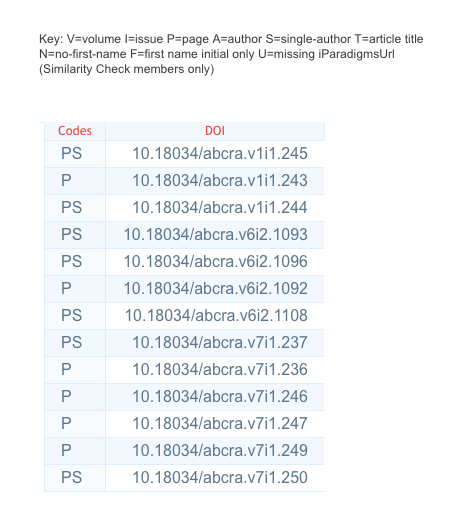
Select a title to retrieve a list of DOIs for the title, and flagged fields for each DOI. For example, the DOIs in this report lack page and author information:
Although the deposit section of the schema specifies that some bibliographic metadata is optional for content registration purposes, we strongly encourage members to register comprehensive metadata for each item registered.
Page maintainer: Isaac Farley Last updated: 2024-July-19