PID strategies are being written around the world right now, and the decisions being made will shape the scholarly record for decades. After 25 years running open scholarly infrastructure—now on behalf of 25,000 members in 167 countries—Crossref has an informed perspective on what those decisions should ideally rest on. Today we’re setting it out in our’s first position paper: Persistent identifiers in research infrastructure policy: the need for a holistic approach. You can read it online or download the PDF; it’s a 16-minute read.
Research is rarely limited to a single contributor performing a single role. Behind every research output are people contributing in various ways: software development, data analyses, methodology design, and much more. Often, the same person contributes in several of these ways. Until now, Crossref metadata could only capture part of that picture, but this is changing with Schema 5.5.
Through user experience research (UXR) initiatives that take into account our diverse membership and community, we can have a continuous, deeper understanding of the role of metadata in our members’ workflows, and ensure that our work continues to meet our community’s needs. Your support is the key to this process, and will positively impact the wider community - and if you’d like to start today, you can take part in our latest initiative: help us improve our Events page by sharing your thoughts on the page’s feedback form.
Our 2026 Community Update took place on 13 May. Two calls, one for the eastern and one for the western time zone, highlighted how our global community is growing, how we’re refining the metadata that supports trust in the scholarly record, and connecting records more effectively through our latest tools.
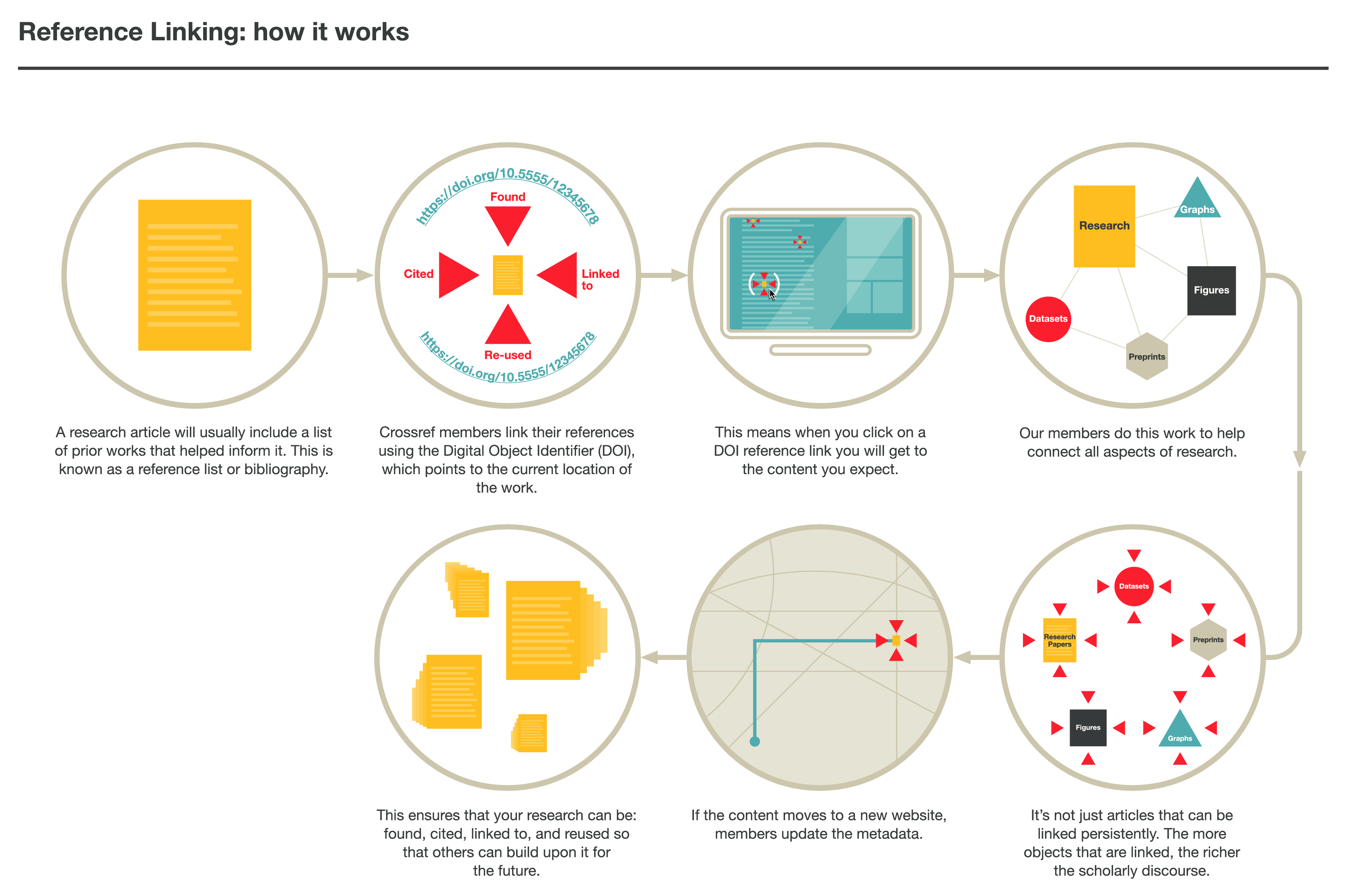
Reference linking enables researchers to follow a link from the reference list to other full-text documents, helping them to make connections and discover new things.
Reference Linking means including Crossref DOIs (displayed as URLs) in the reference lists that you provide in your own published work. This enables researchers to follow a link from a reference list to the current landing page for that referenced work. And because it’s a DOI rather than just a link, it will remain persistent.
So, instead of just including the reference in your reference list…
Soleimani N, Mohabati Mobarez A, Farhangi B. Cloning, expression and purification flagellar sheath adhesion of Helicobacter pylori in Escherichia coli host as a vaccination target. Clin Exp Vaccine Res. 2016 Jan;5(1):19-25.
…you should also display the DOI link:
Soleimani N, Mohabati Mobarez A, Farhangi B. Cloning, expression and purification flagellar sheath adhesion of Helicobacter pylori in Escherichia coli host as a vaccination target. Clin Exp Vaccine Res. 2016 Jan;5(1):19-25. https://doi-org.turing.library.northwestern.edu/10.7774/cevr.2016.5.1.19
Because Crossref is all about rallying the scholarly community to work together, reference linking is an obligation for all Crossref members. But you don’t have to be a Crossref member to link your references - we provide free tools that anyone can use to match their reference lists to existing DOIs so they can link their references.
Watch the introductory reference linking animation in your language:
Persistent links enhance scholarly communications. Reference linking offers important benefits:
Reciprocity: members’ records are linked together and more discoverable because all members link their references.
As a member organisation, we can obligate all our members to link their references, so that individual members can avoid the inconvenience of signing bilateral agreements to link to persistent resources on other platforms. The result is a scholarly communications infrastructure that enables the exchange of ideas and knowledge.
Discoverability: research travels further when everyone links their references. Because DOIs don’t break if implemented correctly, they will always lead readers to the resource they’re looking for, including yours. When the DOIs are displayed, anyone can copy and share them. This will also enable better tracking of where and when people are talking about and sharing scholarly objects, including in social media.
Obligations and fees for reference linking
Reference Linking is an obligation of membership for all Crossref members. But anyone can use our support tools for Reference Linking - you don’t have to be a member. And there’s no charge to use our support tools for Reference Linking.
Getting started with reference linking
There are various different ways to look up other member’s DOIs to add to your reference lists. Read more here.